Clothing Tech Pack Guide: What to Include Before Sending Designs to a Manufacturer
Starting a clothing brand involves more than creating attractive designs. Before a garment can move into production, a manufacturer needs clear instructions about its construction, fabric, measurements, sizing, colors, branding and finishing details.
This is where a clothing tech pack becomes essential.
A clothing tech pack is a technical document that explains how a garment should be manufactured. It helps clothing brands communicate their requirements accurately and allows manufacturers to understand the product before developing samples or starting bulk production.
Whether you are developing oversized T-shirts, hoodies, tracksuits, streetwear, sportswear or private label clothing, preparing a detailed apparel tech pack can help reduce misunderstandings, avoid unnecessary revisions and achieve more consistent production results.
In this guide, we explain what to include in a clothing tech pack and how to prepare one before sending your designs to a clothing manufacturer.
What Is a Clothing Tech Pack?
A clothing tech pack, also known as an apparel tech pack, is a collection of technical information about a garment. It provides the manufacturer with the details required to develop and produce the product according to your specifications.
Instead of explaining every detail through messages, pictures or reference products, you can organize your requirements in one document.
A professional clothing tech pack usually includes:
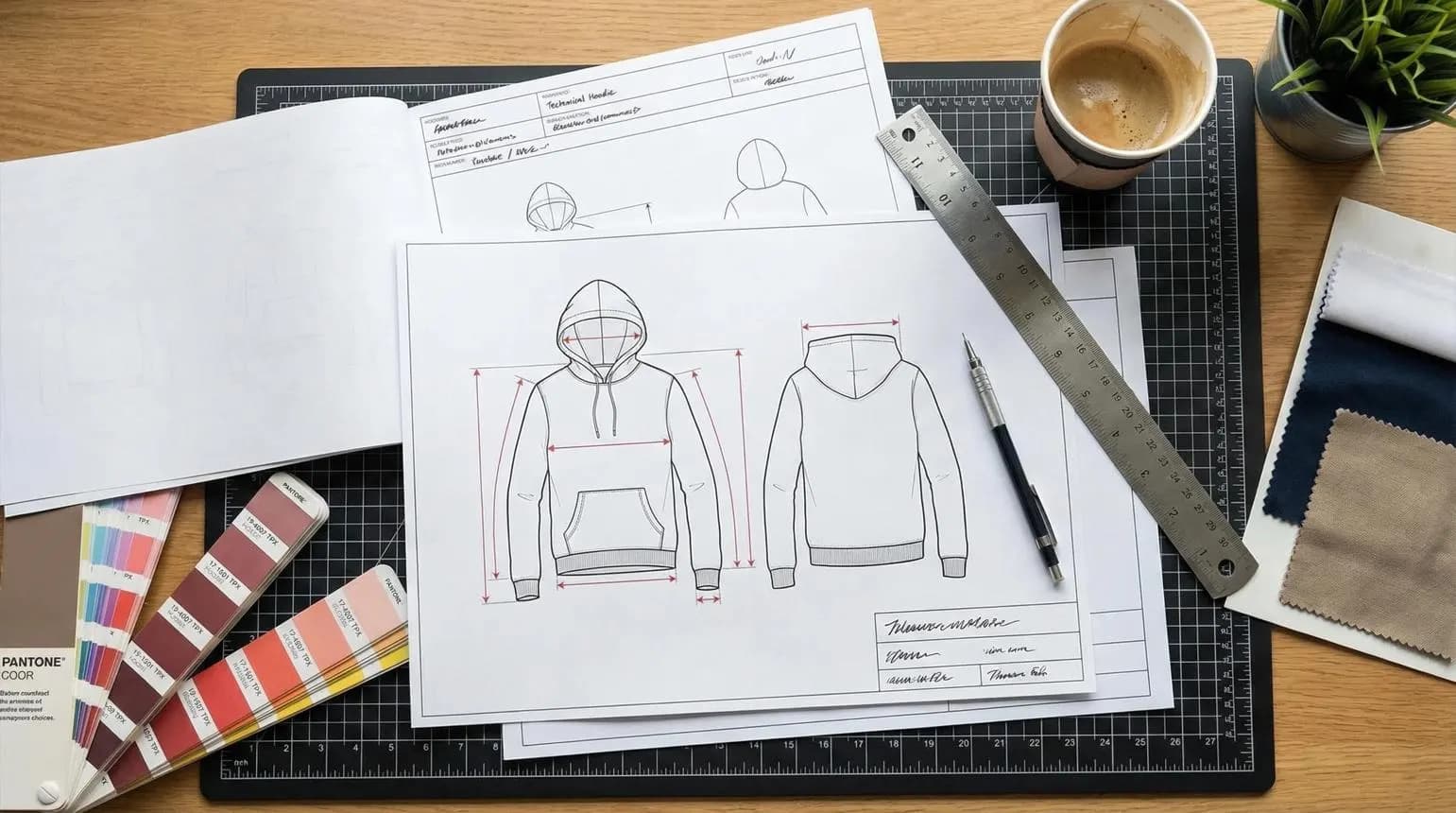
Front and back technical drawings
Fabric composition and GSM
Garment measurements
Size charts and size grading
Color specifications
Logo and artwork placement
Stitching and construction details
Labels and branding requirements
Packaging instructions
Sample and fitting comments
A detailed tech pack is particularly useful when working with an overseas clothing manufacturer because it creates a clear reference for both parties.
1. Technical Drawings and Garment Design
The first important part of a clothing tech pack is the technical drawing.
Technical drawings show how your garment should look from different angles. They help manufacturers understand the overall design, shape, panels, pockets, seams and other construction details.
For most garments, include:
Front view
Back view
Side view, if required
Close-up drawings of special design features
For example, if you are developing an oversized T-shirt, your technical drawing should show the body shape, shoulder drop, sleeve length, neckline and overall silhouette.
For a hoodie, include details such as the hood shape, drawstrings, kangaroo pocket, cuffs, waistband and zipper if applicable.
Your drawings do not have to be complicated, but they should clearly communicate the design. You can create them using Adobe Illustrator, professional tech pack software or another suitable design tool.
2. Fabric Specifications and GSM
Fabric selection has a major impact on the appearance, comfort, durability and overall quality of a garment.
Your tech pack should clearly explain which fabric you want the manufacturer to use.
Important fabric details include:
Fabric composition, such as 100% cotton or a cotton-polyester blend
Fabric GSM (grams per square metre)
Fabric type and construction
Stretch requirements
Texture and surface finish
Desired softness and feel
Special treatments, such as garment washing or acid washing
For example, an oversized streetwear T-shirt might use 100% cotton fabric around 220–260 GSM, depending on the desired weight and fit.
A heavyweight hoodie may use cotton or cotton-polyester fleece around 300–450 GSM, depending on the construction and intended use.
These figures are examples, not fixed requirements. The correct fabric depends on your design, target market, product category and desired quality.
If you have a reference garment or fabric sample, share it with your manufacturer. Physical references can help communicate fabric weight, texture and stretch more accurately.
3. Garment Measurements and Measurement Points
Garment measurements are one of the most important parts of a clothing tech pack.
Even when a manufacturer understands your design, unclear measurements can result in an incorrect fit.
You should provide the finished garment measurements and explain how each measurement should be taken.
Common measurement points include:
For T-shirts and tops:
Chest width
Body length
Shoulder width
Sleeve length
Sleeve opening
Neck width
Front and back neck drop
For hoodies and sweatshirts:
Chest width
Body length
Shoulder width
Sleeve length
Cuff opening
Bottom opening
Hood height and width
For trousers and tracksuit pants:
Waist width
Hip width
Front rise
Back rise
Thigh width
Inseam
Outseam
Leg opening
Always clarify whether measurements are taken flat or around the body. For example, chest width is commonly measured flat from one side of the garment to the other, below the armholes.
You should also mention whether the garment is measured relaxed or stretched, especially for products made with elastic or stretch fabrics.
4. Clothing Size Charts and Size Grading
A clothing size chart is essential when developing products in multiple sizes.
It tells the manufacturer the exact finished measurements required for each size, such as XS, S, M, L, XL and XXL.
Without a proper size chart, a manufacturer may understand the design but still produce garments with incorrect proportions or an unsuitable fit.
Your tech pack should include a complete size chart for every garment style.
For an oversized T-shirt, the size chart may include:
Chest width for each size
Body length for each size
Shoulder width for each size
Sleeve length for each size
Sleeve opening for each size
Neck opening, if required
For tracksuit pants, the size chart may include:
Waist width
Hip width
Front rise
Back rise
Thigh width
Inseam
Outseam
Leg opening
What Is Size Grading in Clothing Manufacturing?
Size grading is the process of adjusting a garment's measurements to create different sizes from an approved base size.
For example, a brand may first develop and approve a medium-sized T-shirt. The manufacturer then uses the agreed grading increments to develop small, large, extra-large and other required sizes.
Size grading should maintain the intended shape and proportions of the original design. Simply increasing every measurement by the same amount does not always produce a correct fit.
Your tech pack should specify:
The base size used for sample approval
All required production sizes
Measurement points for each size
Grading increments between sizes
Acceptable measurement tolerances
Whether measurements are flat, relaxed or stretched
Example of an Oversized T-Shirt Size Chart
For a clearer reference, you can provide finished garment measurements in centimetres.
An illustrative size specification could include:
Small: Chest 56 cm, Length 70 cm, Shoulder 54 cm, Sleeve 22 cm
Medium: Chest 59 cm, Length 72 cm, Shoulder 57 cm, Sleeve 23 cm
Large: Chest 62 cm, Length 74 cm, Shoulder 60 cm, Sleeve 24 cm
Extra Large: Chest 65 cm, Length 76 cm, Shoulder 63 cm, Sleeve 25 cm
These measurements are only an example for an oversized T-shirt. They are not universal size standards. Your actual size chart should reflect your brand's fit, target customers and approved sample.
Before bulk production, make sure the base sample and size grading have been reviewed and approved.
5. Color Specifications and Pantone References
Color consistency is important for clothing brands, especially when producing multiple garments or repeating orders.
Your tech pack should identify the exact colors required for the garment.
You can include:
Main fabric color
Secondary fabric color
Rib or cuff color
Stitching color
Print color
Embroidery thread color
Zipper and accessory color
Whenever possible, provide Pantone color references or physical color samples.
For example, if your hoodie uses a specific navy blue, do not rely only on a screenshot or a general description such as dark blue. A Pantone reference can help communicate the intended color more accurately.
For sublimation printing, provide the final artwork and color references so the manufacturer can understand the required design.
6. Logo Placement, Printing and Embroidery Details
Branding is an important part of private label clothing manufacturing.
Your tech pack should clearly show where each logo, graphic or design element should be placed.
Include:
Logo artwork in a suitable high-resolution or vector format
Exact logo dimensions
Placement on the garment
Distance from seams or garment edges
Printing or embroidery method
Required colors
Any special finishing instructions
Common branding methods include:
Screen printing
Direct-to-film (DTF) printing
Direct-to-garment (DTG) printing
Sublimation printing
Flat embroidery
3D puff embroidery
Chenille embroidery
Appliqué
For example, if your brand logo needs to be embroidered on the left chest of a hoodie, provide the logo file, dimensions and placement reference.
This helps the manufacturer understand your branding requirements before sampling.
7. Stitching and Garment Construction
A clothing tech pack should also explain how the garment needs to be constructed.
Different stitching methods and construction details can affect the appearance, strength and finishing of a product.
Depending on your design, include details such as:
Overlock stitching
Flatlock stitching
Coverstitch
Single-needle stitching
Double-needle stitching
Ribbed cuffs and waistbands
Reinforced seams
Panel construction
Pocket construction
Zipper specifications
For example, an oversized T-shirt may require reinforced shoulder seams and a particular neckline construction.
A sportswear product may require flatlock stitching to help create smooth seams and comfortable movement.
If your design includes unusual panels, seams or finishing techniques, provide close-up references or construction drawings.
8. Labels, Hangtags and Private Label Branding
If you are building your own clothing brand, your tech pack should include all required branding components.
These may include:
Main neck labels
Printed neck labels
Woven labels
Size labels
Care labels
Brand hangtags
Custom patches
Branded packaging stickers
You should provide the label artwork, dimensions, placement and preferred material where applicable.
Also include the information required on care and composition labels for your target market. Labelling requirements can vary by country, so confirm the applicable regulations before production.
Clear branding instructions help ensure that your finished garments reflect your brand identity.
9. Packaging and Presentation Requirements
Packaging is another detail that should be discussed before production.
Some brands require simple bulk packaging, while others want individually packed garments ready for retail or fulfilment.
Your tech pack or packaging specification can include:
Individual polybags
Custom printed bags
Branded stickers
Hangtags
Size stickers
Tissue paper
Carton packing requirements
Special folding instructions
If your products need to be packed individually by size or style, explain this clearly.
You should also discuss packaging requirements with your manufacturer before confirming the order, particularly if you need custom printed packaging or branded accessories.
10. Sample Development and Fit Approval
Before starting bulk production, it is important to develop and review a sample.
A sample allows you to check whether the manufacturer has understood your design and specifications correctly.
During sample approval, review:
Fabric quality and weight
Overall fit and measurements
Stitching and construction
Print or embroidery quality
Color accuracy
Logo placement
Labels and finishing
Packaging, if required
If something needs to be changed, provide clear feedback with measurements, marked-up pictures or written instructions.
Once the sample is approved, it can serve as a reference for bulk production.
Do not assume that a design image alone is enough to confirm the final garment. Physical sample approval is an important step in developing a consistent product.
What If You Do Not Have a Clothing Tech Pack?
Not every clothing brand has a professional tech pack ready.
If you are a startup or developing your first collection, you can still approach a manufacturer with:
Reference product pictures
Front and back design images
Fabric preferences
Available measurements
Size requirements
Logo and artwork files
Branding and packaging ideas
A manufacturer can review your requirements and explain which additional specifications are needed before sampling.
However, the more information you provide at the beginning, the easier it becomes to understand your product and avoid unnecessary revisions.
Clothing Tech Pack Checklist Before Contacting a Manufacturer
Before sending your designs to a clothing manufacturer, check that you have prepared the following information:
Front and back technical drawings
Fabric composition and GSM
Fabric color or Pantone references
Garment measurements
Complete size chart
Base size and size grading instructions
Print or embroidery artwork
Logo placement and dimensions
Stitching and construction details
Labels and branding requirements
Packaging instructions
Sample requirements
You do not need to have every detail finalized before making your first inquiry. However, having these specifications ready will make communication and product development much easier.
How to Choose the Right Clothing Manufacturer for Your Tech Pack
A detailed tech pack is only one part of successful clothing production. Choosing a manufacturer that can understand and follow your specifications is equally important.
When evaluating a clothing manufacturer, consider:
Manufacturing experience: Look for a manufacturer with experience in your product category, whether it is streetwear, activewear, sportswear or private label clothing.
Sampling capability: Ask whether they can develop samples before bulk production and make revisions based on your feedback.
Customization options: Check whether they can support your fabric, colors, printing, embroidery, labels and packaging requirements.
Communication: A reliable manufacturing partner should be able to review your specifications, explain production requirements and communicate any technical limitations.
Production planning: Discuss minimum order quantities, sample timelines, bulk production timelines and shipping arrangements before confirming your order.
A manufacturer should be able to help turn your design requirements into a practical production plan.
Work With TrackXL for Custom Clothing Manufacturing
At TrackXL, we work with clothing brands, retailers, sports clubs and businesses looking for custom apparel manufacturing.
Based in Sialkot, Pakistan, we support OEM and ODM clothing production across a range of categories, including:
Custom oversized T-shirts and streetwear
Private label hoodies and sweatshirts
Custom tracksuits and matching sets
Sportswear and team uniforms
Gymwear and activewear
MMA and combat sportswear
Custom jackets and corporate apparel
Our customization options include embroidery, chenille, appliqué, sublimation, DTF printing, custom labels and branded packaging.
Whether you already have a complete clothing tech pack or are starting with design references, our team can review your requirements and discuss the next steps for sampling and production.
If you are planning your next clothing collection, contact TrackXL to discuss your product specifications and manufacturing requirements.
Website: https://track-xl.com
Email: info@track-xl.com
Frequently Asked Questions About Clothing Tech Packs
What is included in a clothing tech pack?
A clothing tech pack generally includes technical drawings, fabric specifications, garment measurements, size charts, size grading, color references, artwork placement, stitching details, labels and packaging instructions.
Is a tech pack necessary for clothing manufacturing?
A tech pack is highly recommended because it provides manufacturers with clear production instructions. Although you can begin with reference pictures and design details, a complete tech pack helps reduce misunderstandings and improve consistency.
What is the difference between a tech pack and a size chart?
A tech pack is a complete technical document containing the information required to manufacture a garment. A size chart is one part of that document and provides the measurements for different garment sizes.
What is size grading in apparel manufacturing?
Size grading is the process of adjusting a garment's measurements from an approved base size to create other sizes while maintaining the intended fit and proportions.
Can I manufacture clothing without a tech pack?
Yes. You can approach a manufacturer with reference pictures, design files, measurements and fabric preferences. The manufacturer can review your requirements and help identify the additional details needed for sample development.
What file format should I use for a clothing tech pack?
Common formats include PDF, Adobe Illustrator (AI) and other editable design files. A PDF is useful for sharing the complete specifications, while editable files can help with technical revisions.
Should I approve a sample before bulk clothing production?
Yes. Approving a physical sample allows you to check the fit, measurements, fabric, construction, branding and finishing before moving forward with bulk production.
Final Thoughts
A well-prepared clothing tech pack helps turn a design concept into a clear manufacturing specification. From fabric GSM and garment measurements to size charts, grading, stitching and private label branding, every important detail should be communicated before production begins.
If you want to build a clothing brand or develop a new collection, take time to organize your specifications and work with a manufacturer that understands your requirements.
The better your communication before production, the easier it becomes to develop garments that match your brand's expectations.